Monday, April 10, 2017

Nijigahara Holograph


Image result for nijigahara holograph

Nijigahara Holograph is a title I've looked forward to reading for some time.  It ran out of print in hardcover, and used copies of the book were selling for $80 or $100.  When I finally got around to getting a copy, it still cost $27 in hardcover, quite a lot for manga.  But this is a little more than the usual manga; it's art.  Plus, whenever a rare book like this gets reprinted, I usually pick up a copy.  Jodorowsky, Moebius, and Oesterheld books have fetched hundreds of dollars.

But Nijigahara Holograph is something I would've read if it hadn't been rare; that's the difference.  I've read tons of Inio Asano, the creator, and this might be his best work.  He works with slice of life sort of stories, and he's very heavily based in music and the arts.  In Nijigahara Holograph, he takes on bullying with two separate timelines.  It isn't the easiest manga to follow, but it's very rewarding.

Saturday, April 8, 2017

Copperhead #11


Copperhead, Issue #11 is the first issue in this title for a long, long time.  A few blog entries ago, I complained about Hadrian's Wall taking a pair of months off, while Copperhead has been gone since October of 2015.  I started reading the trade paperbacks in early 2016, when I was still buying every Image trade paperback that was coming out.  I liked Copperhead enough to buy the second trade paperback when it came out, and when the new arc started, I bought it.

I'm still in a bit of a rough patch when it comes to reading comics.  They're starting to pile up, and I thought I'd ease my way into the pile today.  It is hard getting back into a comic you haven't read for over a year, but I always liked Copperhead, the Firefly-like story of a woman who takes a job as sheriff on a lonely mining planet.  Despite the layoff, I had no trouble jumping right back into this story.  I look forward to Issue #12.

Thursday, April 6, 2017

Green Lanterns #20


Image result for Green Lanterns #20 humphries

Green Lanterns, Issue #20 contains two stories.  The main story involves Neal Emerson, a brilliant scientist who has gone insane since getting magnetic powers.  The two Green Lanterns, Jessica Cruz and Simon Baz, can't deal with him very well.  Emerson, now known as Dr. Magneto, is too much for Baz and Cruz.  His ultimate undoing will probably be himself.  The other story is Rami and Volthoom, the disgraced Guardian of the Galaxy and the First Lantern, respectively.  The more higher-up Green Lanterns want to know what's going on.

This comic took me less than 10 minutes to read; I read it yesterday, and it's the only DC comic I really follow.  I'm trying with Batwoman and Detective Comics, but neither of them is as readable as Green Lanterns.  Over the past year, I've become a huge Marvel fan at the expense of my DC and in some cases Image Comics reading.

Wednesday, April 5, 2017

The 39 Steps


The 39 Steps by John Buchan was written in 1915 and takes place in 1914, involving a plot to start World War I.  A classic tale of espionage, it begins with a simple murder and involves a chase throughout England and Scotland before the main character, Richard Hannay, decodes the few clues he has and stops the plot from unfolding.  It's really nothing like the 1935 Alfred Hitchcock movie of the same name, which is also good, leaving out the autistic memorist who unwittingly gives away the secret to the 39 Steps before being shot.

I felt like going on a long drive, so I took my Spark up to Anza Borrego State Park for the morning and listened to The 39 Steps on Audible, which cost $2.48.  I also bought the 2013 video game based on the novel for a couple of dollars, but I haven't gotten around to playing it yet.  All-in-all, it was a fun novel and a fun morning.  The book is only four hours long, so it's perfect for the odd road trip.

Not many 1915 novels are still worth reading.  Some are classics, and while I don't think The 39 Steps will make its way into the Western Cannon, it's an excellent study of a very modern adventure.  What would movies of the 1930s, 1940s, and 1950s have been without the idea of a regular guy getting drawn into a murder and a spy thriller?  This novel is the genesis of much of Hitchcock's work, I believe.

Monday, April 3, 2017

Infamous Iron Man #6


Infamous Iron Man (2016-) #6

Infamous Iron Man, Issue #6 begins, strangely enough, with Victor Von Doom and Reed Richards as college students.  Reed wants to be friends, and Von Doom wants to be left alone.  It then skips ahead to the present day, where Von Doom is Infamous Iron Man, Von Doom's long-dead mother is alive and young, and Reed Richards is sleeping with Mommy Von Doom, also known as Cynthia, the sorceress.

This is a weird Iron Man series.  I just can't get used to sympathizing with Von Doom and not Reed Richards.  There's no outward signal that Richards is going to be the antagonist of this series besides him sleeping with Mommy Von Doom, but there's a decidedly evil vibe imparted on him by the creators, which include artists Alex Maleev and Matt Hollingsworth.  At the end of the comic, an appearance by Riri Williams/Ironheart is teased for Issue #7.

Hadrian's Wall #5


Hadrian's Wall, Issue #5 begins five years in the past of the main story, with Simon confronting Edward about the affair he thinks Edward is having with  Terry.  It's a reminder of the story so far.  Now Edward and Simon are on a space station where there's been a murder; Edward is dead.  The title does suffer a little bit from the hiatus between the first four issues and the last four issues, which begin with this comic.  The boarding, the murder, the ex-wife.  It all comes back eventually.

The rebels board the Hadrian's Wall at the end of Issue #4, if memory serves correctly.  It turns out that Edward was working with them but got cold feet.  Simply put, a lot of good comics came out last Wednesday, and while it's a bad sign that I didn't read any of them until today, Monday, I did enjoy being sucked into the world of Hadrian's Wall for 15 minutes.  The creators of C.O.W.L. really put a good issue together.  Maybe I'll read another comic.

Saturday, April 1, 2017

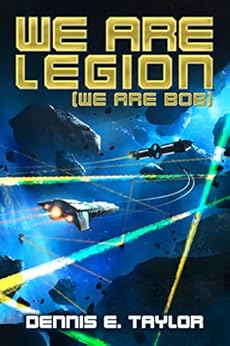
We Are Legion (We Are Bob)


Image result for we are legion we are bob

We Are Legion (We Are Bob) is my current audiobook, and I thought I'd review it while I'm halfway into it.  My reasons are twofold: first, while I'm finished with 80% of the books I read when I actually write out my reviews, some books I review as I'm reading them; and second, I've gotten out of the habit of reviewing the novels I read because I usually read audiobooks, and once one ends, another begins.  I originally named this blog "Elmenreich Books," not "Elmenreich Comics," which it has become.

We Are Legion (We Are Bob) won an Audible Award for "Best Science Fiction Novel."  I downloaded it on my now-defunct Amazon Unlimited account and paid an extra $2 or $3 for the audiobook version of the novel, which survived me quitting Amazon Unlimited.  It's about nine-and-a-half hours long, and it's based on the concept of a von Neumann probe.  The idea of self-replicating probes have been around in hard sci-fi since the original draft of 2001: A Space Odyssey, written by Arthur C. Clarke and Stanley Kubrick.  The scene never made it into the 1969 movie or the novel based on the movie.  Charles Sheffield published Cold as Ice in 1992, and it specifically mentions "von Neumann machines," which are self-replicating probes that are designed to populate the galaxy following a natural or human-made catastrophe on Earth.

Dennis E. Taylor takes the idea and runs with it, adding in a main character, Bob, who has his head frozen after dying in a car accident outside a science-fiction convention in the present day.  The fact that he dies just after attending a panel about von Neumann probes involves a suspension of disbelief, but it works fine as a framing device.  By a strange coincidence, I had just finished reading Zero K by Don DeLillo, also published in 2016 and also based on a wealthy character getting his head frozen.  The two novels are nothing similar, for reasons that should be obvious to anyone familiar with Don DeLillo's turgid yet beautiful prose and his use of the absurd.

Bob is woken up 117 years after his death to learn that his body and brain have been destroyed.  He is merely a computer simulation based on the brain chemistry of his body, which became state property in 2042.  He also copies his programming to find out that the copies have entirely different personalities of their own.  A mix of hard sci-fi, political sci-fi, and post-apocalyptic sci-fi continues; a sequel is forthcoming later this month, which I will most assuredly buy.  This is going to be a great series.