Tuesday, June 13, 2017

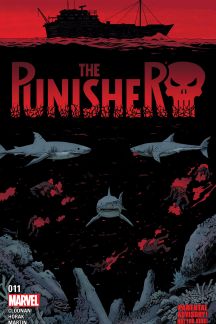
The Punisher #11


The Punisher (2016) #11

The Punisher, Issue #11 begins with Frank Castle tied up on a ship full of EMC, the super-soldier drug C.O.N.D.O.R. wants to sell to fuel its drug enterprise.  I don't think it's that much of a spoiler to tell you what happens next.  Of course, the Punisher gets out of danger, blows up the ship, and kills everyone - that's what he does - but the way he does it is imaginative and well realized, and I've become a fan of Becky Cloonan's Punisher.

The arc and maybe the series will conclude with Issue #12; I hope the series doesn't.  I haven't been reading too many comics, but this is one of the series that gets me right back into the swing of things.  I've been hacking for Lyft, and between rides I read audiobooks.  This has taken up a lot of my book-reading and comic-reading energy, but damn.  The Punisher is awesome, and I've really enjoyed this iteration.  I'll go back and buy Vol. 3 and Vol. 4 of The Punisher MAX: The Complete Collection as soon as I finish this and get to work on that.

Saturday, June 10, 2017

SpecOps


Bildergebnis für specops alanson

SpecOps is the second book in the "Expeditionary Force" series by Craig Alanson, and it's very good science fiction.  A mix of military sci-fi and comedy, it fits a unique niche in the literary world.  Joe Bishop is an average guy who finds himself, along with an absent-minded A.I. who's millions of years old, in charge of a starship with a crew of 12 scientists and 56 soldiers from various countries, including himself.  Most of the soldiers are highly trained "special operations" forces.

I've continued to enjoy this textured and vast vision of the galaxy.  The books are longish at 15 or 16 hours, and I liked the first book so much that I bought the second and third right away.  The comedy mostly comes in the form of the A.I. named "Skippy," who's constantly forgetting things and constantly insulting Joe Bishop and the crew.  It is light entertainment, not as dark as its predecessor.  Since reading SpecOps, I've moved onto something denser, but I'm a fan.

Friday, June 9, 2017

Saga #43


Saga #43

Saga, Issue #43 comes to you at the blindingly cheap price of $0.25; it starts a new arc and briefly recaps the series for people reading it for the first time.  In Issue #42, Alana gets kicked in the stomach, and the baby is pretty much dead.  Alana will die if the baby isn't removed, but there are two problems.  She's eight months pregnant - and the baby still has a beating heart - so local laws don't allow an abortion.  Also, any abortion she does have will expose her half-Landfalian/half-Wreathian child to the world.

Saga doesn't shy away from controversy, but it still remains a great comic.  The abortion laws mirror those of Ireland, where a woman can't get an abortion for any reason while the unborn fetus still has a beating heart.  Baby and mother going to die?  Let 'em die, even if they aren't Catholic, even if they aren't Irish citizens.   I wrote about queer theory in my last review, and there's a trans character traveling with the family.  Hazel, Marco and Alana's daughter, asks the trans character about her penis, for instance.

Steam Clean


Steam clean by laura Ķeniņš

Steam Clean takes place in a sauna for women in Europe, where a group of women has gathered for a queer party.  A lot of people don't understand why there's a "Q" in "LGBTQ," so I'll briefly explain: "queer" refers to all of the above in "LGBTQ" and more.  "Queer" doesn't assume binary genders or binary sexuality, so someone might be homoflexible, meaning they are mostly homosexual but occasionally go for other genders as well.  The group of women include a few friends, a FTM transgender who has had top surgery, and a goddess.

No, they don't all go at it once they get naked; get your mind out of the gutter.  They talk, about gender fluidity, sexuality, online dating, not fitting in, work inequality, date rape, and queer theory.  I found the longish (84 page) Retrofit title to be fairly interesting.  The artwork is done with color pencil, and it has detailed backgrounds with simple yet recognizable faces.  I can't begin to explain the techniques used because I'm not an artist, but the overall impression is one of tension.  The women argue and discuss sensitive matters.

Tuesday, June 6, 2017

Stories of Your Life and Others


File:Stories of your life cover.jpg

Stories of Your Life and Others is a 2002 collection of science-fiction short stories written roughly over the previous decade, the titular story of which was the inspiration for the movie Arrival (2016).  Spanning a number of topics from the Tower of Babel to language to enhanced intelligence, Stories of Your Life and Others brings to light an underappreciated art form.  The death of newspapers and magazines has gone hand-in-hand with the death of the short story.  While short stories continue to be the bases of popular movies, I'm afraid that soon, the only place short stories will be read is in the classroom, along with poetry and other vestiges of the past.

That is too bad because there are a number of great short-story writers out there, including Stephen King and Haruki Murakami.  Philip K. Dick wrote scores of popular short stories in the 1950s and 1960s, but he mostly gave up on the medium, as did other science-fiction writers, for a more lucrative form of expression, the novel.  I didn't love every short story in this collection - one never does - but these stories inspire me to look out for more short fiction, and that's the best praise I can give them.

Sunday, June 4, 2017

The Secret Garden


Image result for The Secret Garden

The Secret Garden is a book that haunted my childhood.  I hadn't read it before, but I was told its story by my grandmother.  One day, in the third grade, I was puking my guts out at school.  Me being picked up halfway through school was a rare occurrence, since any time I was remotely ill, I would whine and cry until my mother let me stay home alone and watch TV.  On that day, my grandmother picked me up.  She drove me home, and instead of letting me watch TV, she spent two hours telling me the story of The Secret Garden.

I always meant to read the book, but by the time I'd forgotten enough of it to enjoy the story, I'd already outgrown it, moving on to Isaac Asimov and Star Wars.  The previous two books I've read, Jose Saramago's Blindness and Alice Walker's The Color Purple, are decidedly bleak books.  I don't know if I was ready for a book as candy-red as The Secret Garden, but it was pleasant, nonetheless.  I think I'll get back into something a tiny bit heavier next.

Thursday, June 1, 2017

Blindness


Book cover of Ensaio sobre a Cegueira.jpg

Blindness is one of the most terrifying books I've ever read.  Written by 1998 Portuguese Nobel Laureate, Jose Saramago in 1995, it tells the story of a mysterious white blindness that infects Saramago's home nation of Portugal.  Just as Dante tortures Italians in The Divine Comedy, Saramago tortures the members of his nation, portraying them as quite awful human beings in addition to infecting them with an illness that basically wipes them out.  The heart of the novel takes place in an internment camp, where people struck by the blindness and suspected of being struck by the blindness are housed with minimal facilities and minimal food.

The first third of the book sets up the scene and the characters in the abandoned mental hospital that is used to intern the blind people in hopes of keeping the sickness from spreading.  It is dark, but one could almost imagine it being a high-school play.  Then it turns into equal parts Andersonville and Lord of the Flies, plus well, you can guess what they do to the women.  The final third sees the main characters escaping the camp as the blindness spreads to the entire nation.

I read the audiobook, which is a lot easier than reading Saramago in print.  Saramago doesn't use quotation marks or paragraph breaks to separate the different speakers.  This distinction is effected in the audiobook by the narrator using different and consistent voices for each character.  Blindness is an incredible piece of literature, and it was mentioned in particular by the Nobel committee when it awarded Saramago the Nobel Prize in Literature in 1998.  I've already bought another book by this author.